Thursday, October 10, 2013

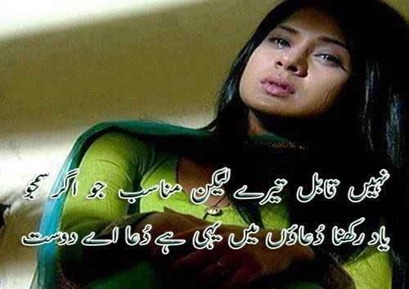
Sad Poetry in Roman Urduin Urdu SMS in Urdu Pics by Wasi Shah Wallpapers About Love on Facebook in English

Sad Poetry in Roman Urdu Biography

Source(Gogle.com.pk)
Mirza Asadullah Baig Khan (Urdu/Persian: مرزا اسد اللہ بیگ خان ), pen-name Ghalib (Urdu/Persian: غالب, ġhālib means dominant) and (former pen-name) Asad (Urdu/Persian: اسد, asad means lion) (27 December 1797 — 15 February 1869), was a classical Urdu and Persian poet from India during British colonial rule. During his lifetime the Mughals were eclipsed and displaced by the British and finally deposed following the defeat of the Indian rebellion of 1857, events that he wrote of. Most notably, he wrote several ghazals during his life, which have since been interpreted and sung in many different ways by different people. He is considered, in South Asia, to be the one of the most popular and influential poets of the Urdu language. Ghalib today remains popular amongst Urdu speakers not only in India and Pakistan but also amongst diaspora communities around the world.He never worked for a livelihood, lived on either state patronage, credit or the generosity of his friends.
His fame came to him posthumously. He had himself remarked during his lifetime that although his age had ignored his greatness, it would be recognized by later generations.

Poetry Career
Although Ghalib himself was far prouder of his poetic achievements in Persian, he is today more famous for his Urdu ghazals. Numerous elucidations of Ghalib's ghazal compilations have been written by Urdu scholars. The first such elucidation or Sharh was written by Ali Haider Nazm Tabatabai of Hyderabad during the rule of the last Nizam of Hyderabad. Before Ghalib, the ghazal was primarily an expression of anguished love; but Ghalib expressed philosophy, the travails and mysteries of life and wrote ghazals on many other subjects, vastly expanding the scope of the ghazal. This work is considered his paramount contribution to Urdu poetry and literature.

In keeping with the conventions of the classical ghazal, in most of Ghalib's verses, the identity and the gender of the beloved is indeterminate. The critic/poet/writer Shamsur Rahman Faruqui explains that the convention of having the "idea" of a lover or beloved instead of an actual lover/beloved freed the poet-protagonist-lover from the demands of realism. Love poetry in Urdu from the last quarter of the seventeenth century onwards consists mostly of "poems about love" and not "love poems" in the Western sense of the term.

The first complete English translation of Ghalib's ghazals was written by Sarfaraz K. Niazi and published by Rupa & Co in India and Ferozsons in Pakistan. The title of this book is Love Sonnets of Ghalib and it contains complete Roman transliteration, explication and an extensive lexicon.

Mirza Ghalib was a gifted letter writer. Not only Urdu poetry but the prose is also indebted to Mirza Ghalib. His letters gave foundation to easy and popular Urdu. Before Ghalib, letter writing in Urdu was highly ornamental. He made his letters "talk" by using words and sentences as if he were conversing with the reader. According to him "sau kos se ba-zaban-e-qalam baatein kiya karo aur hijr mein visaal ke maze liya karo" [ from hundred of miles talk with the tongue of the pen and enjoy the joy of meeting even when you are separated] His letters were very informal, some times he would just write the name of the person and start the letter. He himself was very humorous and also made his letter very interesting. He said "main koshish karta hoon keh koi aisi baat likhoon jo parhay khoosh ho jaaye" [ I want to write the lines that whoever reads those should enjoy it] When the third wife of one of his friends died, he wrote... Some scholar says that Ghalib would have the same place in Urdu literature if only on the basis of his letters.They have been translated into English by Ralph Russell, The Oxford Ghalib.

Ghalib was a chronicler of this turbulent period.One by one, Ghalib saw the bazaars – Khas Bazaar, Urdu Bazaar, Kharam-ka Bazaar, disappear, whole mohallas (localities) and katras (lanes) vanish. The havelis (mansions) of his friends were razed to the ground. Ghalib wrote that Delhi had become a desert. Water was scarce. Delhi was now “ a military camp”. It was the end of the feudal elite to which Ghalib had belonged. He wrote:

“An ocean of blood churns around me- Alas! Were these all!
The future will show
What more remains for me to see”.

Popular legend has it that he changed his pen name to 'Ghalib' when he came across this sher (couplet) by another poet who used the takhallus (pen name) 'Asad':

The legend says that upon hearing this couplet, Ghalib ruefully exclaimed, "whoever authored this couplet does indeed deserve the Lord's rahmat (mercy) (for having composed such a deplorable specimen of Urdu poetry). If I use the takhallus Asad, then surely (people will mistake this couplet to be mine and) there will be much la'anat (curse) on me!" And, saying so, he changed his takhallus to 'Ghalib'.

However, this legend is little more than a figment of the legend-creator's imagination.takhallus 'Asad' appears more infrequently in Ghalib's work than 'Ghalib', it appears that he did use both his noms de plume interchangeably throughout his career and did not seem to prefer either one over the other.

Personal Life

Mirza was born in Kala Mahal in Agra. In the end of 18th century, his birthplace was converted into Indrabhan Girls' Inter College. The birth room of Mirza Ghalib is preserved within in the school. Around 1810, he was married to Umrao Begum, daughter of Nawab Ilahi Bakhsh Khan of Loharu (younger brother of the first Nawab of Loharu, Nawab Mirza Ahmad Baksh Khan , at the age of thirteen. He had seven children, none of whom survived (this pain has found its echo in some of Ghalib's ghazals). There are conflicting reports regarding his relationship with his wife. She was considered to be pious, conservative and God-fearing.

Ghalib was proud of his reputation as a rake. He was once imprisoned for gambling and subsequently relished the affair with pride. Once, when someone praised the poetry of the pious Sheikh Sahbai in his presence, Ghalib immediately retorted, "How can Sahbai be a poet? He has never tasted wine, nor has he ever gambled; he has not been beaten with slippers by lovers, nor has he ever seen the inside of a jail." In the Mughal court circles, he even acquired a reputation as a "ladies' man".

He died in Delhi on February 15, 1869. The house where he lived in Gali Qasim Jaan, Ballimaran, Chandni Chowk, in Old Delhi has now been turned into 'Ghalib Memorial' and houses a permanent Ghalib exhibition.

Popular Culture

Indian Cinema has paid a tribute to the legendary poet through a film (in sepia/black and white) named Mirza Ghalib (1954) in which Bharat Bhushan plays Ghalib and Suraiya plays his courtesan lover, Chaudvin. The musical score of the film was composed by Ghulam Mohammed and his compositions of Ghalib's famous ghazals are likely to remain everlasting favorites.

Pakistan Cinema has also paid tribute to the legendary poet through another film also named Mirza Ghalib. The film was directed by M.M. Billoo Mehra and produced as well by M.M. Billoo Mehra for S.K. Pictures. The music was composed by Tassaduq Hussain. The film starred Pakistan film superstar Sudhir playing Ghalib and Madam Noor Jehan playing his courtesan lover, Chaudvin. The film was released on November 24, 1961 and reached average status at the box-office, however, the music remains memorable in Pakistan to this day.

Gulzar produced a TV serial, Mirza Ghalib (1988), telecast on DD National and was quite well-accepted and liked by viewers. Naseeruddin Shah played the role of Ghalib in the serial, and it featured ghazals sung and composed by Jagjit Singh and Chitra Singh.

The Pakistan government in 1969 commissioned Khaliq Ibrahim (died 2006) to make a documentary on Mirza Ghalib. The movie was completed in 1971-72. It is said, that the movie, a docudrama, was historically more correct than what the official Pakistan government point of view was. Thus, it was never released. Till this date, barring a few private viewing, the movie is lying with the Department of Films and Publication, Government of Pakistan. The movie was made on 16 mm format. Ghalib's role was played by actor Subhani Bayunus, who later played this role in many TV productions.

Various theatre groups have staged plays related to the life of Mirza Ghalib. These have shown different lifestyles and the way he lived his life.

Contemporaries and Disciples

Ghalib's closest rival was poet Zauq, tutor of Bahadur Shah Zafar II, the then emperor of India with his seat in Delhi. There are some amusing anecdotes of the competition between Ghalib and Zauq and exchange of jibes between them. However, there was mutual respect for each other's talent. Both also admired and acknowledged the supremacy of Meer Taqi Meer, a towering figure of 18th century Urdu Poetry. Another poet Momin, whose ghazals had a distinctly lyrical flavour, was also a famous contemporary of Ghalib. Ghalib as not only a poet, he was also a prolific prose writer. His letters are a reflection of the political and social climate of the time. They also refer to many contemporaries like Mir Mehdi Majrooh, who himself was a good poet and Ghalib's life-long acquaintance.

Ghalib in today's culture

Ghalib's is still very popular today, and his poetry is well known.

LABELS: GHALIB POETRY, MIRZA GHALIB BIOGRAPHY
AT 7:34 AM
0 COMMENTS:

POST A COMMENT


Newer Post Older Post Home
Subscribe to: Post Comments (Atom)
Search

Classical Poets
Ahmad Sabih Poetry (5)
Allama Iqbal Poetry (20)
Faiz Ahmed Faiz Poetry (3)
Faraz Poetry (23)
Ghalib Poetry (30)
Ibn-e-Insha Poetry (4)
John Elia Poetry (48)
Meena Kumari Poetry (1)
Meer Taqi Meer Poetry (4)
Mohsin Poetry (13)
Parveen Shakir Poetry (21)
Saghir Siddiqui Poetry (1)
Wasi Shah Poetry (10)
Popular Posts

Allama Iqbal Poetry: Tere Ishq Ki Inteha Chahta Hu
John Elia Poetry
Mirza Ghalib Biography
Ibtada-e-Ishq Hai Rota Hai Kya
John Elia Biography
Sentimental Poetry Stuff
classical poetry (276)
designed poetry (15)
english poetry stuff (10)
ghazal (15)
love poetry (124)
nice poetry (198)
romantic poetry (62)
sad poetry (20)
types of poetry (162)
urdu poetry (166)
Archive
► 2011 (7)
▼ 2010 (254)
► December (3)
► October (4)
► August (17)
► July (23)
▼ June (50)
Tum Mera Naam Kyon Nahin Lete
Hai Mohabbat Hayat Ki Lazzat
Humesha Muskura Kay Aansooun Ko Chupaya
Yaad Aaon Tu Bas Itni Si Inayat Karna
Ghalib Poetry
Samaan-E-Tijarat Mera Iman Nahi Hai
Khamoshi Keh Rahi Hai Kan Mein Kya
Safha-E-Waqt Pe Likhi Tehreer Badal Jati Hai
Woh Log The Qadmon Se Zameen Cheen Rahe Hain
Baat Nikalegii To Phir Duur Talak Jaayegii
John Elia Poetry
Uski Ankh0n K0 Kabhi Gh0r Se Dekha Hy Faraz
Shab-E-Tanhai Mein Sitaron Ka Libada Orrhey
Yehi Gar Zid Tumhari Hai
Dil Udaas Hai Bahut Koyi Paigaam Hi Likh Do
Faasle Aise Bhi Honge Ye Kabhi Socha Na Tha
Jane Kyon Log Mere Naam Se Jal Jate Hai
Urdu Poetry
Rut Jo Badli To Badalte Dekha Usko
Sochiye To Husn Itna Bewafa Hota Nahi.
Ghar Ki Wehshat Se Larzta Hun Magar Jane Kyon
Zara Sa Dhiyan Rakh Lena Meri Pehli Mohabbat Hai
Tujh Se Bichad Ke Hum Bhi Muqaddar Ke Ho Gaye
Main Saahil Pey Likhi Hoee Ibaarat Nahee
Kahin Aarzo-e-Safar Nahe, Kahin Manzilon Ko Khabar...
Mere Dard Ko Jo Zuban Milay
Ye Larki Faqa Kash Hoti To Badsoorat Nazar Ati
Naya Ek Rishta Paida Kiu Karain Ham
Uske Pehlu Se Lag Ke Chalte Hain
Ye Sach Hai Umer Bhar Pehli Muhabbat Yaad Rehti Ha...
Wafa Main Ab Ye Hunar Ikhtiyaar Karna Hai
Main Talkhi Hayat Se Ghabra K Pee Gaya
Jo Is Shor Se 'Mir' Rota Rahega
Is Shehar Main Jii Ka Lagana Kia
Ek Baar Kaho Tum Meri Ho
Insha G Utho Ab Kuch Karo, Is Shaher Main Jee Ko L...
Har Haqeeqat Majaaz Ho Jaaye
Ibn-e-Insha Biography
Aziz Itnaa Hi Rakho Ke Ji Sanbhal Aaye
Tiflaan-e-Koocha Gard K Pat'thar Bhi Kuch Nahin
Ab Bhi Ajaoo
Tujhay Dekha Hai Jo Darya Ne Idhar Atay Hue,
Aankh Se Duur Na Ho Dil Se Utar Jaayega
Aashiqi Be-Dili Se Mushkil Hai
Kaun Sood-o- Ziyan Ki Dunya Main
Tum Mera Dukh Baant Rahi ho Main Khud Say Sharmind...
Samjh Jaana Ke Woh Mein Hu
Mirza Ghalib Biography
Ab Jo Ik Hasrat-e-Jawani Hai
Koi Halat Nahe Yae Halat Hay
► May (23)
► March (2)
► February (98)
► January (34)
► 2009 (63)
Biographies of Classical Poets
Ibn-e-Insha Biography (1)
John Elia Biography (1)
Mirza Ghalib Biography (1)
Request Center


Top Selected Poetry
Top Selected Poetry Stuff (19)
Peaple On My Blog
 Poetry Blogs - BlogCatalog Blog Directory Blog Directory &    Search enginePersonal Blogs - Blog Rankings PageHeatPersonal Blog       Directory Add site Free submit your site and be ranked today! Literature blogs
Followers

Pageviews last month
6484
My Network
free web site trafffic and promotionIncrease traffic Birthday SMS softsonnets.blogspot.com Tattoos Designs and Ideas

Sad Poetry in Roman Urduin Urdu SMS in Urdu Pics by Wasi Shah Wallpapers About Love on Facebook in English

Sad Poetry in Roman Urduin Urdu SMS in Urdu Pics by Wasi Shah Wallpapers About Love on Facebook in English

Sad Poetry in Roman Urduin Urdu SMS in Urdu Pics by Wasi Shah Wallpapers About Love on Facebook in English

Sad Poetry in Roman Urduin Urdu SMS in Urdu Pics by Wasi Shah Wallpapers About Love on Facebook in English

Sad Poetry in Roman Urduin Urdu SMS in Urdu Pics by Wasi Shah Wallpapers About Love on Facebook in English

Sad Poetry in Roman Urduin Urdu SMS in Urdu Pics by Wasi Shah Wallpapers About Love on Facebook in English

Sad Poetry in Roman Urduin Urdu SMS in Urdu Pics by Wasi Shah Wallpapers About Love on Facebook in English

Sad Poetry in Roman Urduin Urdu SMS in Urdu Pics by Wasi Shah Wallpapers About Love on Facebook in English
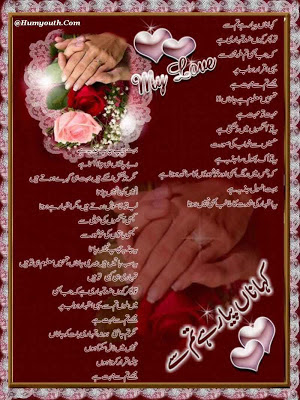
Sad Poetry in Roman Urduin Urdu SMS in Urdu Pics by Wasi Shah Wallpapers About Love on Facebook in English

Sad Poetry in Roman Urduin Urdu SMS in Urdu Pics by Wasi Shah Wallpapers About Love on Facebook in English

Sad Poetry in Roman Urduin Urdu SMS in Urdu Pics by Wasi Shah Wallpapers About Love on Facebook in English

Sad Poetry in Roman Urduin Urdu SMS in Urdu Pics by Wasi Shah Wallpapers About Love on Facebook in English

Sad Poetry in Roman Urduin Urdu SMS in Urdu Pics by Wasi Shah Wallpapers About Love on Facebook in English

Sad Poetry in Roman Urduin Urdu SMS in Urdu Pics by Wasi Shah Wallpapers About Love on Facebook in English

Sad Poetry in Roman Urduin Urdu SMS in Urdu Pics by Wasi Shah Wallpapers About Love on Facebook in English

Sad Poetry in Roman Urduin Urdu SMS in Urdu Pics by Wasi Shah Wallpapers About Love on Facebook in English

Sad Poetry in Roman Urduin Urdu SMS in Urdu Pics by Wasi Shah Wallpapers About Love on Facebook in English

Urdu Sad Love Poetry in Urdu SMS in Urdu Pics by Wasi Shah Wallpapers About Love on Facebook in English

Urdu Sad Love Poetry Biography

Source(Gogle.com.pk)
Mirza Asadullah Baig Khan (Urdu/Persian: مرزا اسد اللہ بیگ خان ), pen-name Ghalib (Urdu/Persian: غالب, ġhālib means dominant) and (former pen-name) Asad (Urdu/Persian: اسد, asad means lion) (27 December 1797 — 15 February 1869), was a classical Urdu and Persian poet from India during British colonial rule. During his lifetime the Mughals were eclipsed and displaced by the British and finally deposed following the defeat of the Indian rebellion of 1857, events that he wrote of. Most notably, he wrote several ghazals during his life, which have since been interpreted and sung in many different ways by different people. He is considered, in South Asia, to be the one of the most popular and influential poets of the Urdu language. Ghalib today remains popular amongst Urdu speakers not only in India and Pakistan but also amongst diaspora communities around the world.He never worked for a livelihood, lived on either state patronage, credit or the generosity of his friends.
His fame came to him posthumously. He had himself remarked during his lifetime that although his age had ignored his greatness, it would be recognized by later generations.

Poetry Career
Although Ghalib himself was far prouder of his poetic achievements in Persian, he is today more famous for his Urdu ghazals. Numerous elucidations of Ghalib's ghazal compilations have been written by Urdu scholars. The first such elucidation or Sharh was written by Ali Haider Nazm Tabatabai of Hyderabad during the rule of the last Nizam of Hyderabad. Before Ghalib, the ghazal was primarily an expression of anguished love; but Ghalib expressed philosophy, the travails and mysteries of life and wrote ghazals on many other subjects, vastly expanding the scope of the ghazal. This work is considered his paramount contribution to Urdu poetry and literature.

In keeping with the conventions of the classical ghazal, in most of Ghalib's verses, the identity and the gender of the beloved is indeterminate. The critic/poet/writer Shamsur Rahman Faruqui explains that the convention of having the "idea" of a lover or beloved instead of an actual lover/beloved freed the poet-protagonist-lover from the demands of realism. Love poetry in Urdu from the last quarter of the seventeenth century onwards consists mostly of "poems about love" and not "love poems" in the Western sense of the term.

The first complete English translation of Ghalib's ghazals was written by Sarfaraz K. Niazi and published by Rupa & Co in India and Ferozsons in Pakistan. The title of this book is Love Sonnets of Ghalib and it contains complete Roman transliteration, explication and an extensive lexicon.

Mirza Ghalib was a gifted letter writer. Not only Urdu poetry but the prose is also indebted to Mirza Ghalib. His letters gave foundation to easy and popular Urdu. Before Ghalib, letter writing in Urdu was highly ornamental. He made his letters "talk" by using words and sentences as if he were conversing with the reader. According to him "sau kos se ba-zaban-e-qalam baatein kiya karo aur hijr mein visaal ke maze liya karo" [ from hundred of miles talk with the tongue of the pen and enjoy the joy of meeting even when you are separated] His letters were very informal, some times he would just write the name of the person and start the letter. He himself was very humorous and also made his letter very interesting. He said "main koshish karta hoon keh koi aisi baat likhoon jo parhay khoosh ho jaaye" [ I want to write the lines that whoever reads those should enjoy it] When the third wife of one of his friends died, he wrote... Some scholar says that Ghalib would have the same place in Urdu literature if only on the basis of his letters.They have been translated into English by Ralph Russell, The Oxford Ghalib.

Ghalib was a chronicler of this turbulent period.One by one, Ghalib saw the bazaars – Khas Bazaar, Urdu Bazaar, Kharam-ka Bazaar, disappear, whole mohallas (localities) and katras (lanes) vanish. The havelis (mansions) of his friends were razed to the ground. Ghalib wrote that Delhi had become a desert. Water was scarce. Delhi was now “ a military camp”. It was the end of the feudal elite to which Ghalib had belonged. He wrote:

“An ocean of blood churns around me- Alas! Were these all!
The future will show
What more remains for me to see”.

Popular legend has it that he changed his pen name to 'Ghalib' when he came across this sher (couplet) by another poet who used the takhallus (pen name) 'Asad':

The legend says that upon hearing this couplet, Ghalib ruefully exclaimed, "whoever authored this couplet does indeed deserve the Lord's rahmat (mercy) (for having composed such a deplorable specimen of Urdu poetry). If I use the takhallus Asad, then surely (people will mistake this couplet to be mine and) there will be much la'anat (curse) on me!" And, saying so, he changed his takhallus to 'Ghalib'.

However, this legend is little more than a figment of the legend-creator's imagination.takhallus 'Asad' appears more infrequently in Ghalib's work than 'Ghalib', it appears that he did use both his noms de plume interchangeably throughout his career and did not seem to prefer either one over the other.

Personal Life

Mirza was born in Kala Mahal in Agra. In the end of 18th century, his birthplace was converted into Indrabhan Girls' Inter College. The birth room of Mirza Ghalib is preserved within in the school. Around 1810, he was married to Umrao Begum, daughter of Nawab Ilahi Bakhsh Khan of Loharu (younger brother of the first Nawab of Loharu, Nawab Mirza Ahmad Baksh Khan , at the age of thirteen. He had seven children, none of whom survived (this pain has found its echo in some of Ghalib's ghazals). There are conflicting reports regarding his relationship with his wife. She was considered to be pious, conservative and God-fearing.

Ghalib was proud of his reputation as a rake. He was once imprisoned for gambling and subsequently relished the affair with pride. Once, when someone praised the poetry of the pious Sheikh Sahbai in his presence, Ghalib immediately retorted, "How can Sahbai be a poet? He has never tasted wine, nor has he ever gambled; he has not been beaten with slippers by lovers, nor has he ever seen the inside of a jail." In the Mughal court circles, he even acquired a reputation as a "ladies' man".

He died in Delhi on February 15, 1869. The house where he lived in Gali Qasim Jaan, Ballimaran, Chandni Chowk, in Old Delhi has now been turned into 'Ghalib Memorial' and houses a permanent Ghalib exhibition.

Popular Culture

Indian Cinema has paid a tribute to the legendary poet through a film (in sepia/black and white) named Mirza Ghalib (1954) in which Bharat Bhushan plays Ghalib and Suraiya plays his courtesan lover, Chaudvin. The musical score of the film was composed by Ghulam Mohammed and his compositions of Ghalib's famous ghazals are likely to remain everlasting favorites.

Pakistan Cinema has also paid tribute to the legendary poet through another film also named Mirza Ghalib. The film was directed by M.M. Billoo Mehra and produced as well by M.M. Billoo Mehra for S.K. Pictures. The music was composed by Tassaduq Hussain. The film starred Pakistan film superstar Sudhir playing Ghalib and Madam Noor Jehan playing his courtesan lover, Chaudvin. The film was released on November 24, 1961 and reached average status at the box-office, however, the music remains memorable in Pakistan to this day.

Gulzar produced a TV serial, Mirza Ghalib (1988), telecast on DD National and was quite well-accepted and liked by viewers. Naseeruddin Shah played the role of Ghalib in the serial, and it featured ghazals sung and composed by Jagjit Singh and Chitra Singh.

The Pakistan government in 1969 commissioned Khaliq Ibrahim (died 2006) to make a documentary on Mirza Ghalib. The movie was completed in 1971-72. It is said, that the movie, a docudrama, was historically more correct than what the official Pakistan government point of view was. Thus, it was never released. Till this date, barring a few private viewing, the movie is lying with the Department of Films and Publication, Government of Pakistan. The movie was made on 16 mm format. Ghalib's role was played by actor Subhani Bayunus, who later played this role in many TV productions.

Various theatre groups have staged plays related to the life of Mirza Ghalib. These have shown different lifestyles and the way he lived his life.

Contemporaries and Disciples

Ghalib's closest rival was poet Zauq, tutor of Bahadur Shah Zafar II, the then emperor of India with his seat in Delhi. There are some amusing anecdotes of the competition between Ghalib and Zauq and exchange of jibes between them. However, there was mutual respect for each other's talent. Both also admired and acknowledged the supremacy of Meer Taqi Meer, a towering figure of 18th century Urdu Poetry. Another poet Momin, whose ghazals had a distinctly lyrical flavour, was also a famous contemporary of Ghalib. Ghalib as not only a poet, he was also a prolific prose writer. His letters are a reflection of the political and social climate of the time. They also refer to many contemporaries like Mir Mehdi Majrooh, who himself was a good poet and Ghalib's life-long acquaintance.

Ghalib in today's culture

Ghalib's is still very popular today, and his poetry is well known.

LABELS: GHALIB POETRY, MIRZA GHALIB BIOGRAPHY
AT 7:34 AM
0 COMMENTS:

POST A COMMENT


Newer Post Older Post Home
Subscribe to: Post Comments (Atom)
Search

Classical Poets
Ahmad Sabih Poetry (5)
Allama Iqbal Poetry (20)
Faiz Ahmed Faiz Poetry (3)
Faraz Poetry (23)
Ghalib Poetry (30)
Ibn-e-Insha Poetry (4)
John Elia Poetry (48)
Meena Kumari Poetry (1)
Meer Taqi Meer Poetry (4)
Mohsin Poetry (13)
Parveen Shakir Poetry (21)
Saghir Siddiqui Poetry (1)
Wasi Shah Poetry (10)

Popular Posts

Allama Iqbal Poetry: Tere Ishq Ki Inteha Chahta Hu
John Elia Poetry
Mirza Ghalib Biography
Ibtada-e-Ishq Hai Rota Hai Kya
John Elia Biography

Sentimental Poetry Stuff
classical poetry (276)
designed poetry (15)
english poetry stuff (10)
ghazal (15)
love poetry (124)
nice poetry (198)
romantic poetry (62)
sad poetry (20)
types of poetry (162)
urdu poetry (166)

Archive
► 2011 (7)
► April (5)
► February (1)
► January (1)
▼ 2010 (254)
► December (3)
► October (4)
► August (17)
► July (23)
▼ June (50)
Tum Mera Naam Kyon Nahin Lete
Hai Mohabbat Hayat Ki Lazzat
Humesha Muskura Kay Aansooun Ko Chupaya
Yaad Aaon Tu Bas Itni Si Inayat Karna
Ghalib Poetry
Samaan-E-Tijarat Mera Iman Nahi Hai
Khamoshi Keh Rahi Hai Kan Mein Kya
Safha-E-Waqt Pe Likhi Tehreer Badal Jati Hai
Woh Log The Qadmon Se Zameen Cheen Rahe Hain
Baat Nikalegii To Phir Duur Talak Jaayegii
John Elia Poetry
Uski Ankh0n K0 Kabhi Gh0r Se Dekha Hy Faraz
Shab-E-Tanhai Mein Sitaron Ka Libada Orrhey
Yehi Gar Zid Tumhari Hai
Dil Udaas Hai Bahut Koyi Paigaam Hi Likh Do
Faasle Aise Bhi Honge Ye Kabhi Socha Na Tha
Jane Kyon Log Mere Naam Se Jal Jate Hai
Urdu Poetry
Rut Jo Badli To Badalte Dekha Usko
Sochiye To Husn Itna Bewafa Hota Nahi.
Ghar Ki Wehshat Se Larzta Hun Magar Jane Kyon
Zara Sa Dhiyan Rakh Lena Meri Pehli Mohabbat Hai
Tujh Se Bichad Ke Hum Bhi Muqaddar Ke Ho Gaye
Main Saahil Pey Likhi Hoee Ibaarat Nahee
Kahin Aarzo-e-Safar Nahe, Kahin Manzilon Ko Khabar...
Mere Dard Ko Jo Zuban Milay
Ye Larki Faqa Kash Hoti To Badsoorat Nazar Ati
Naya Ek Rishta Paida Kiu Karain Ham
Uske Pehlu Se Lag Ke Chalte Hain
Ye Sach Hai Umer Bhar Pehli Muhabbat Yaad Rehti Ha...
Wafa Main Ab Ye Hunar Ikhtiyaar Karna Hai
Main Talkhi Hayat Se Ghabra K Pee Gaya
Jo Is Shor Se 'Mir' Rota Rahega
Is Shehar Main Jii Ka Lagana Kia
Ek Baar Kaho Tum Meri Ho
Insha G Utho Ab Kuch Karo, Is Shaher Main Jee Ko L...
Har Haqeeqat Majaaz Ho Jaaye
Ibn-e-Insha Biography
Aziz Itnaa Hi Rakho Ke Ji Sanbhal Aaye
Tiflaan-e-Koocha Gard K Pat'thar Bhi Kuch Nahin
Ab Bhi Ajaoo
Tujhay Dekha Hai Jo Darya Ne Idhar Atay Hue,
Aankh Se Duur Na Ho Dil Se Utar Jaayega
Aashiqi Be-Dili Se Mushkil Hai
Kaun Sood-o- Ziyan Ki Dunya Main
Tum Mera Dukh Baant Rahi ho Main Khud Say Sharmind...
Samjh Jaana Ke Woh Mein Hu
Mirza Ghalib Biography
Ab Jo Ik Hasrat-e-Jawani Hai
Koi Halat Nahe Yae Halat Hay
► May (23)
► March (2)
► February (98)
► January (34)
► 2009 (63)
► December (63)

Biographies of Classical Poets
Ibn-e-Insha Biography (1)
John Elia Biography (1)
Mirza Ghalib Biography (1)

Request Center


Top Selected Poetry
Top Selected Poetry Stuff (19)

Peaple On My Blog

Poetry Blogs - BlogCatalog Blog Directory Blog Directory &    Search enginePersonal Blogs - Blog Rankings PageHeatPersonal Blog       Directory Add site Free submit your site and be ranked today! Literature blogs

Followers


Pageviews last month
6473

My Network
free web site trafffic and promotionIncrease traffic Birthday SMS softsonnets.blogspot.com Tattoos Designs and Ideas


Cultu UR Technologie Directory Shane Engli

Urdu Sad Love Poetry in Urdu SMS in Urdu Pics by Wasi Shah Wallpapers About Love on Facebook in English

Urdu Sad Love Poetry in Urdu SMS in Urdu Pics by Wasi Shah Wallpapers About Love on Facebook in English

Urdu Sad Love Poetry in Urdu SMS in Urdu Pics by Wasi Shah Wallpapers About Love on Facebook in English

Urdu Sad Love Poetry in Urdu SMS in Urdu Pics by Wasi Shah Wallpapers About Love on Facebook in English

Urdu Sad Love Poetry in Urdu SMS in Urdu Pics by Wasi Shah Wallpapers About Love on Facebook in English

Urdu Sad Love Poetry in Urdu SMS in Urdu Pics by Wasi Shah Wallpapers About Love on Facebook in English

Urdu Sad Love Poetry in Urdu SMS in Urdu Pics by Wasi Shah Wallpapers About Love on Facebook in English

Urdu Sad Love Poetry in Urdu SMS in Urdu Pics by Wasi Shah Wallpapers About Love on Facebook in English

Urdu Sad Love Poetry in Urdu SMS in Urdu Pics by Wasi Shah Wallpapers About Love on Facebook in English

Urdu Sad Love Poetry in Urdu SMS in Urdu Pics by Wasi Shah Wallpapers About Love on Facebook in English

Urdu Sad Love Poetry in Urdu SMS in Urdu Pics by Wasi Shah Wallpapers About Love on Facebook in English

Urdu Sad Love Poetry in Urdu SMS in Urdu Pics by Wasi Shah Wallpapers About Love on Facebook in English

Urdu Sad Love Poetry in Urdu SMS in Urdu Pics by Wasi Shah Wallpapers About Love on Facebook in English

Urdu Sad Love Poetry in Urdu SMS in Urdu Pics by Wasi Shah Wallpapers About Love on Facebook in English

Urdu Sad Love Poetry in Urdu SMS in Urdu Pics by Wasi Shah Wallpapers About Love on Facebook in English

Urdu Sad Love Poetry in Urdu SMS in Urdu Pics by Wasi Shah Wallpapers About Love on Facebook in English

Urdu Sad Love Poetry in Urdu SMS in Urdu Pics by Wasi Shah Wallpapers About Love on Facebook in English

Sad Poetry Messages in Urdu SMS in Urdu Pics by Wasi Shah Wallpapers About Love on Facebook in English

Sad Poetry Messages Biography

Source(Gogle.com.pk)

Bano Qudsia (born 1928) is a writer, intellectual, playwright and spiritualist from Pakistan who is regarded among the best Urdu novelists and short story writers of modern times. She is best known for her novel Raja Gidh. She writes for television and stage in both Urdu and Punjabi languages. She is the wife of famous novelist Ashfaq Ahmed. She has written a number of popular television plays.Bano moved with her family to Lahore during the Partition of India. Her father, a landlord with a Bachelor's degree in agriculture, died when Bano was very young. She attended school in Dharamsala in eastern India before moving to Lahore. Her mother, Mrs. Chattah, was an educationalist, and this inspired the young Bano to develop a keen interest in academics, which turned her into a conscientious student. Her marriage to Ashfaq Ahmed consummated the artist in her, though she says she never discussed any of her works with her husband nor has the writer-spouse ever tried to influence her writings. "We work very independently. Writing a book is like bearing a child and you do not share that with anyone. God is your only confidant. It is also like falling in love. You keep it personal and private.As a student, she wrote for college magazines and other journals. Her memories of her days at Kinnaird College in Lahore, from where she graduated, are still quite vivid. She talks of the literary inspiration that was a hallmark at Kinnaird's campuses during those days. Though her stay at Kinnaird went a long way in sharpening her scholarly skills, Bano felt an incessant need to polish her expressions in Urdu, the only language with which she could reach the minds of the people. So in 1951, she completed her M.A. degree in Urdu from the Government College Lahore with distinction.She has authored numerous short stories, novelettes, television and radio plays, and stage plays. Her short stories include Baz Gasht, Amar Bail, Doosra Darwaza and Twajju ki Talib. Of her novels, none has received as much recognition as Raja Gidh which centers around the forbidden truth. The plot buildsaround the symbol of a vulture, a bird of prey, that feeds on dead flesh and carcasses. The moral sought implies that indulgence in the forbidden leads to physical and mental degeneration.Some of her best plays include Tamasil, Hawa key Naam, Seharay and Khaleej. The plight of women and other socio-economic issues have often been the subject of her television serials that have inspired families wherever they have been aired. The Graduate Award for Best Playwright was conferred on Bano in 1986, followed by the same award for three consecutive years from 1988 to 1990. In 1986, she was also given the Taj Award for Best Playwright.Rather critical of the deviation of today's woman from her natural role of mother and home keeper, Bano decries what she terms 'a woman's unsolicited and disoriented escape from responsibility.' Interestingly, though, she blames men for plotting a conspiracy to push women out of the house, her only domain. "And women fall easy prey to this trap. Men of the post-industrialization era gave women a taste of luxurious lifestyles and then instigated them to step out of the house and earn that lifestyle. The woman developed a taste for what she thought was freedom for her, but which actually bonded her as a labourer and a breadwinner."She cites the example of the woman who does the dishes in her home. "This woman is more liberated than your modern women, since she does not suffer from any conflicts of the 'self'. Poverty is all that hurts her and she is not caught in a rat race to prove something to herself or carve out an identity for herself. Her existence is identity enough.Bano also feels that what she calls women's 'strength of softness' has been lost in their struggle to prove themselves equal to men. What women take as their weaknesses are in fact their strengths, she believes.Bano Qudsia planned to co-author a book with her (now late) husband. Her obligations towards her family are much more important for her than her work. "My husband (now late), my three sons and daughter-in-law have all been very kind to me and have always showered their affections on me. So, how can I ever put anything else before them?"Having lived a fulfilling life, which Bano ascribes to the benevolence of those around her, she kept herself busy caring for her husband. She is now working on her present literary undertaking - a novel which she plans to title Dastan Serai, after her home. "I formally started work on this novel in 1992. Prior to this, I had worked on it during the 1950s. The novel is set against the backdrop of Partition and revolvesaround the theme of intention and motivation. It highlights the importance of intention as the key determinant behind every act.
- See more at: http://www.tafreehmella.com/threads/famous-writers-and-poets-biography.188937/#sthash.TUo8pgT8.dpufHabib jalib is one of the Pioneer Urdu poets. He was born on 24 March 1928 in a village near Hoshiarpur, India. He transmigrated to Pakistan after the partition of India and worked as a reader for Daily Imroze of Karachi.

He was a liberal writer and soon started to catch the consultation with his keen practice of poetry. He wrote in plain language, adopted a simple style and addressed common people and issues. But the condemnation behind his words, the music of his voice and his emotional energy coped with the sensibility of the socio-political circumstance is what invoked the audience.

Donpk.com is sharing Habib Jalib Best Poetry Collection, Habib jalib shayari, habib jalib love Poetry, habib jalib Sad Poetry and much more……..

Habib Jalib Best Poetry Collection on DONPK.COM

Wo Bi Khayif Nahi Takhta-e Dar Se
Mai Bi Mansoor Hoon Keh Do Aghayar Se
Kun Darate Ho Zindan Ki Deewar Se
Zulm Ki Baat Ku Jahl Ki Raat Ku
Main Nahi Manta Main Nahi Janta

Tum Ne Loota Hai Sadyon Hmara Sukoon
Ab Na Ham Par Chale Ga Tumhara Fasoon
Chara Gar Main Tumhain Kis Tarah Se Kahon
Main Nahi Manta Main Nahi Janta

Deep Jis Ka Mahlaat Main Hi Jale
Chand Logo Ki Khushiyon Ko Le Kar Chale
Wo Jo Saye Main Har Maslihat Ke Play

Aese Dastoor Ko Subah-e Be Noor Ku
Main Nahi Manta Main Nahi Janta

Sad Poetry Messages in Urdu SMS in Urdu Pics by Wasi Shah Wallpapers About Love on Facebook in English

Sad Poetry Messages in Urdu SMS in Urdu Pics by Wasi Shah Wallpapers About Love on Facebook in English

Sad Poetry Messages in Urdu SMS in Urdu Pics by Wasi Shah Wallpapers About Love on Facebook in English

Sad Poetry Messages in Urdu SMS in Urdu Pics by Wasi Shah Wallpapers About Love on Facebook in English

Sad Poetry Messages in Urdu SMS in Urdu Pics by Wasi Shah Wallpapers About Love on Facebook in English

Sad Poetry Messages in Urdu SMS in Urdu Pics by Wasi Shah Wallpapers About Love on Facebook in English

Sad Poetry Messages in Urdu SMS in Urdu Pics by Wasi Shah Wallpapers About Love on Facebook in English

Sad Poetry Messages in Urdu SMS in Urdu Pics by Wasi Shah Wallpapers About Love on Facebook in English

Sad Poetry Messages in Urdu SMS in Urdu Pics by Wasi Shah Wallpapers About Love on Facebook in English

Sad Poetry Messages in Urdu SMS in Urdu Pics by Wasi Shah Wallpapers About Love on Facebook in English

Sad Poetry Messages in Urdu SMS in Urdu Pics by Wasi Shah Wallpapers About Love on Facebook in English

Sad Poetry Messages in Urdu SMS in Urdu Pics by Wasi Shah Wallpapers About Love on Facebook in English

Sad Poetry Messages in Urdu SMS in Urdu Pics by Wasi Shah Wallpapers About Love on Facebook in English

Sad Poetry Messages in Urdu SMS in Urdu Pics by Wasi Shah Wallpapers About Love on Facebook in English

Sad Poetry Messages in Urdu SMS in Urdu Pics by Wasi Shah Wallpapers About Love on Facebook in English

Sad Poetry Messages in Urdu SMS in Urdu Pics by Wasi Shah Wallpapers About Love on Facebook in English

Sad Poetry Messages in Urdu SMS in Urdu Pics by Wasi Shah Wallpapers About Love on Facebook in English

Sad Urdu Poetry Shayari in Urdu SMS in Urdu Pics by Wasi Shah Wallpapers About Love on Facebook in English

Sad Urdu Poetry Shayari Biography

Source(Gogle.com.pk)

Bano Qudsia (born 1928) is a writer, intellectual, playwright and spiritualist from Pakistan who is regarded among the best Urdu novelists and short story writers of modern times. She is best known for her novel Raja Gidh. She writes for television and stage in both Urdu and Punjabi languages. She is the wife of famous novelist Ashfaq Ahmed. She has written a number of popular television plays.Bano moved with her family to Lahore during the Partition of India. Her father, a landlord with a Bachelor's degree in agriculture, died when Bano was very young. She attended school in Dharamsala in eastern India before moving to Lahore. Her mother, Mrs. Chattah, was an educationalist, and this inspired the young Bano to develop a keen interest in academics, which turned her into a conscientious student. Her marriage to Ashfaq Ahmed consummated the artist in her, though she says she never discussed any of her works with her husband nor has the writer-spouse ever tried to influence her writings. "We work very independently. Writing a book is like bearing a child and you do not share that with anyone. God is your only confidant. It is also like falling in love. You keep it personal and private.As a student, she wrote for college magazines and other journals. Her memories of her days at Kinnaird College in Lahore, from where she graduated, are still quite vivid. She talks of the literary inspiration that was a hallmark at Kinnaird's campuses during those days. Though her stay at Kinnaird went a long way in sharpening her scholarly skills, Bano felt an incessant need to polish her expressions in Urdu, the only language with which she could reach the minds of the people. So in 1951, she completed her M.A. degree in Urdu from the Government College Lahore with distinction.She has authored numerous short stories, novelettes, television and radio plays, and stage plays. Her short stories include Baz Gasht, Amar Bail, Doosra Darwaza and Twajju ki Talib. Of her novels, none has received as much recognition as Raja Gidh which centers around the forbidden truth. The plot buildsaround the symbol of a vulture, a bird of prey, that feeds on dead flesh and carcasses. The moral sought implies that indulgence in the forbidden leads to physical and mental degeneration.Some of her best plays include Tamasil, Hawa key Naam, Seharay and Khaleej. The plight of women and other socio-economic issues have often been the subject of her television serials that have inspired families wherever they have been aired. The Graduate Award for Best Playwright was conferred on Bano in 1986, followed by the same award for three consecutive years from 1988 to 1990. In 1986, she was also given the Taj Award for Best Playwright.Rather critical of the deviation of today's woman from her natural role of mother and home keeper, Bano decries what she terms 'a woman's unsolicited and disoriented escape from responsibility.' Interestingly, though, she blames men for plotting a conspiracy to push women out of the house, her only domain. "And women fall easy prey to this trap. Men of the post-industrialization era gave women a taste of luxurious lifestyles and then instigated them to step out of the house and earn that lifestyle. The woman developed a taste for what she thought was freedom for her, but which actually bonded her as a labourer and a breadwinner."She cites the example of the woman who does the dishes in her home. "This woman is more liberated than your modern women, since she does not suffer from any conflicts of the 'self'. Poverty is all that hurts her and she is not caught in a rat race to prove something to herself or carve out an identity for herself. Her existence is identity enough.Bano also feels that what she calls women's 'strength of softness' has been lost in their struggle to prove themselves equal to men. What women take as their weaknesses are in fact their strengths, she believes.Bano Qudsia planned to co-author a book with her (now late) husband. Her obligations towards her family are much more important for her than her work. "My husband (now late), my three sons and daughter-in-law have all been very kind to me and have always showered their affections on me. So, how can I ever put anything else before them?"Having lived a fulfilling life, which Bano ascribes to the benevolence of those around her, she kept herself busy caring for her husband. She is now working on her present literary undertaking - a novel which she plans to title Dastan Serai, after her home. "I formally started work on this novel in 1992. Prior to this, I had worked on it during the 1950s. The novel is set against the backdrop of Partition and revolvesaround the theme of intention and motivation. It highlights the importance of intention as the key determinant behind every act.
- See more at: http://www.tafreehmella.com/threads/famous-writers-and-poets-biography.188937/#sthash.LCvGfVQ3.dpuf

Sad Urdu Poetry Shayari in Urdu SMS in Urdu Pics by Wasi Shah Wallpapers About Love on Facebook in English

Sad Urdu Poetry Shayari in Urdu SMS in Urdu Pics by Wasi Shah Wallpapers About Love on Facebook in English

Sad Urdu Poetry Shayari in Urdu SMS in Urdu Pics by Wasi Shah Wallpapers About Love on Facebook in English

Sad Urdu Poetry Shayari in Urdu SMS in Urdu Pics by Wasi Shah Wallpapers About Love on Facebook in English

Sad Urdu Poetry Shayari in Urdu SMS in Urdu Pics by Wasi Shah Wallpapers About Love on Facebook in English

Sad Urdu Poetry Shayari in Urdu SMS in Urdu Pics by Wasi Shah Wallpapers About Love on Facebook in English

Sad Urdu Poetry Shayari in Urdu SMS in Urdu Pics by Wasi Shah Wallpapers About Love on Facebook in English

Sad Urdu Poetry Shayari in Urdu SMS in Urdu Pics by Wasi Shah Wallpapers About Love on Facebook in English

Sad Urdu Poetry Shayari in Urdu SMS in Urdu Pics by Wasi Shah Wallpapers About Love on Facebook in English


Sad Urdu Poetry Shayari in Urdu SMS in Urdu Pics by Wasi Shah Wallpapers About Love on Facebook in English

Sad Urdu Poetry Shayari in Urdu SMS in Urdu Pics by Wasi Shah Wallpapers About Love on Facebook in English

Sad Urdu Poetry Shayari in Urdu SMS in Urdu Pics by Wasi Shah Wallpapers About Love on Facebook in English

Sad Urdu Poetry Shayari in Urdu SMS in Urdu Pics by Wasi Shah Wallpapers About Love on Facebook in English

Sad Urdu Poetry Shayari in Urdu SMS in Urdu Pics by Wasi Shah Wallpapers About Love on Facebook in English

Sad Urdu Poetry Shayari in Urdu SMS in Urdu Pics by Wasi Shah Wallpapers About Love on Facebook in English

Sad Urdu Poetry Shayari in Urdu SMS in Urdu Pics by Wasi Shah Wallpapers About Love on Facebook in English

Sad Urdu Poetry Shayari in Urdu SMS in Urdu Pics by Wasi Shah Wallpapers About Love on Facebook in English